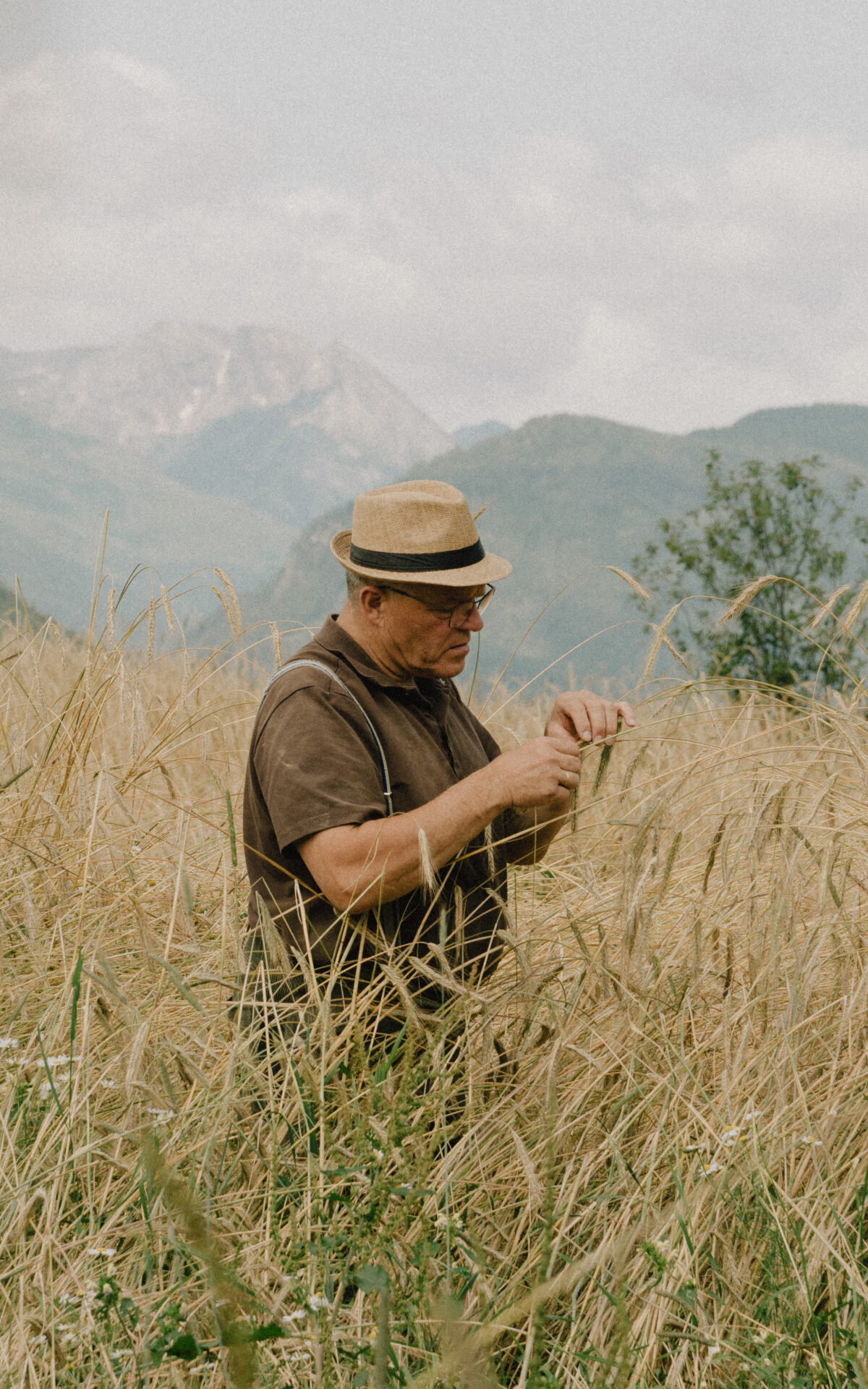
The “Esserbauer” farm in the Salzburg region has been in operation for 150 years and is now in its fifth generation. Today, it is run by 55-year-old Manfred Eisl, and the sixth generation is already working hard on the farm. The farm was traditionally a mixed operation with grassland, animals and agriculture —a tradition that Manfred’s parents briefly interrupted, but which he revived. In addition to his work, he enjoys hunting, cycling, and climbing the mountains in his area.
JB In a few words: What does your farm stand for?
ME For family, sustainability, and circular economy.
JB Was ist deine größte Motivation, Landwirt zu sein – wofür setzt du dich ein?
ME I became a farmer out of tradition, but with great joy. I am aware that I have only borrowed the farm from the next generation. That’s why I must not exploit it, but must improve the soil. This can only be done in an organic and sustainable way – without chemical synthetic substances. Earthworms are more important than the machinery, even if many people don’t understand that yet.


JB What do you do differently than the others?
ME I don’t plan everything out, but accept what nature dictates. If there is no water, nothing will grow. The farmer may contribute 10 %, but nature determines the rest.
JB What is your vision for the farm — how should it develop in the future?
ME We want to be as independent as possible. We started 30 years ago with our own well, and later added a photovoltaic system. For me, using as few machines as possible is also part of independence.
JB And what is your vision for the nature?
ME It would be desirable to have agriculture that works exclusively organically. Chemical synthetic fertilizers and pesticides should have disappeared long ago — we can live very well without them. It is important that we treat nature with care and start thinking for ourselves.
JB Why and how are you committed to humus build-up and biodiversity?
ME The soil is our most important foundation. Humus retains water and provides nutrients. Plants such as peas and field beans collect nitrogen from the air and release it into the soil via their roots. This means there is no need for artificial fertilizers from the warehouse.
JB What distinguishes Laufener Landweizen from other modern grain varieties?
ME Laufener Landweizen has been cultivated and adapted in the region for centuries — unlike modern hybrid varieties. Together with other farmers, I was able to revive it. Although it has a lower output, its golden brown color and height of 1.80 m make it a special sight. It also promotes biodiversity: 50 to 70 accompanying herbs were found in our fields. Each one is a habitat for up to ten insects – that’s up to 700 insects in one field.
JB Why are you planting Laufener Landweizen?
ME Because it belongs to our region — and to our diet. Wheat has fallen into disrepute, but old local varieties such as Laufener Landweizen are more digestible and nutritionally valuable. It contains a lot of carotene, more vitamin B, and more minerals. Our customers confirm this over and over.
Manfred Eisl
Manfred Eisl is the fifth generation to run the “Esserbauer” farm in St. Georgen in the Salzburg region. With his Laufener Landweizen, he is committed to preserving regional ancient grains, humus build-up and biodiversity. His goal is independent, organic farming that strengthens the soil and ensures a healthy base for future generations.